
How Is AI Skin Analysis Changing Professional Consultation?

Updated: Aug 11
How Data-Driven Beauty Consultation Works in Practice
As AI becomes more common across beauty retail and professional consultation, one question naturally follows:
“Will AI eventually replace skin consultation?”
Recent developments in offline beauty suggest a different direction.
While product information and personalization technologies continue to advance, customers still value the experience of speaking directly with an expert and receiving guidance that reflects their individual situation.
This is particularly true in skincare.


Even when two customers receive similar analysis results, the meaning can change depending on the products they currently use, the season, lifestyle, environment, and how their skin actually feels.
For this reason, the role of AI in professional consultation is better understood differently.
AI measures and structures the information.Professionals interpret and explain it.Brands connect the result with products and services.
This is also how ChoiceDx approaches AI analysis in professional beauty environments.
AI Does Not Replace the Consultation. It Gives Professionals Better Evidence to Explain
Experienced aestheticians and beauty consultants observe the skin and listen to the customer.
They ask what products are currently being used, whether the customer has experienced recent discomfort or irritation, and whether lifestyle or environmental conditions have changed.
That human context remains essential.
There are, however, moments when experience alone can be difficult to communicate clearly.
Why should hydration be prioritized now?
Does the customer’s perceived concern match what is visible in the analysis?
What has changed since the previous visit?
Can another consultant begin from a similar reference point?
Can a global brand provide a comparable consultation experience across different markets and stores?
In these situations, analysis data is not an answer that replaces professional judgment.
It becomes a shared reference that the customer and professional can review together.
In the DIBI MILANO professional consultation case, ChoiceDx is used to capture skin images and structure key observations before the professional explains care priorities, products, and treatments with the customer.


Beyond One-Time Accuracy: Can the Result Be Compared Again?
Accuracy is often the first specification discussed when evaluating a professional skin analyzer.
It matters.
But in environments where customers return regularly, another question is equally important:
“Can the same customer be compared using a consistent reference at the next visit?”
ChoiceDx Research examined analysis stability using 265 participants across Fitzpatrick skin types I–VI, standardized imaging and calibration, comparison with expert evaluation, and a three-repeat capture protocol.
The reason for this type of validation is practical.
In professional consultation, a convincing result today is useful. But being able to evaluate how the same customer has changed over time can be even more valuable.
For aesthetic centers, spas, and beauty counters with recurring customers, the direction of change may become a more useful consultation reference than a single absolute score.
Global Consultation Requires More Than an Algorithm
For global brands, repeatability also needs to be considered together with skin-tone diversity.
Image-based AI analysis ultimately works from captured images.
Lighting, camera conditions, distance, focus, and skin tone can all affect how the input image is represented.
For that reason, evaluating the algorithm alone is not enough.
The optical environment, capture protocol, calibration, image correction, and validation across diverse skin tones all matter.
ChoiceDx Research treats standardized capture and calibration as important elements for reducing variability caused by skin tone and imaging conditions.


This becomes particularly relevant for brands operating across multiple countries.
If a customer is captured one way in Seoul and another way in Milan, the starting point of consultation may already differ before the analysis is even interpreted.
Professional expertise should remain personal.
The measurement starting point, however, should be as consistent as possible.
This is one of the areas where AI analysis can support global professional consultation.


What Does AI-Supported Consultation Look Like in Practice?
Adding AI does not require completely rebuilding the consultation process.
In many cases, it simply makes an existing workflow more structured.
1. Understand the customer’s current concerns
Begin with the customer’s perceived skin concerns, current products, and care goals.
2. Capture the relevant areas
Use a professional analyzer to record the skin under a defined imaging process.
3. Structure the information with AI
Convert the captured images into organized metrics and visual results.
4. Review the same screen together
Instead of the professional reading the result alone, the customer and consultant review the images together.
5. Add professional context
Consider current products, previous irritation, lifestyle, environment, and what the customer actually feels.
6. Discuss products or treatments
Use the analysis as one reference when explaining relevant product categories or treatment priorities.
7. Save the result
Where supported, connect the result to the customer’s consultation history.
8. Compare at the next visit
Capture again under similar conditions and review the direction of change.
The BECOS ChoiceDx case follows a similar flow: high-resolution imaging, AI analysis and visualization, professional review, care-priority discussion, product and treatment consultation, and follow-up comparison.
When these stages are connected, the analyzer becomes less of a measurement device and more of a component within the consultation process.
What DIBI MILANO and BECOS Have in Common
DIBI MILANO and BECOS are different professional aesthetic brands.
Their use of ChoiceDx, however, reveals a similar approach.
First, understand the skin.Then explain it.Then connect the insight with products and care.
At DIBI MILANO, the skin is not assessed only through visual inspection. Images are captured and key observations are structured so the professional can discuss current condition, care priorities, products, treatments, and future comparisons.
BECOS follows a similar approach. High-resolution images and structured results are reviewed together by the professional and customer before the discussion moves into products and treatments.
In both cases, technology does not move ahead of professional expertise.
It works behind the professional, making the explanation more concrete.
That distinction matters in professional beauty consultation.

The Value Changes When Consultation Becomes a Record
Professional consultation often does not end after one visit.
When a customer returns, the ability to review the previous skin condition and earlier consultation can create continuity.
ChoiceDx Professional materials describe a structure in which customer data can be managed and compared by date and analysis item, allowing previous results to support future consultation. The platform can also connect analysis results with personalized product information.
The goal is not simply to store more data.
The more important question is:
Can the information needed for the next consultation be retrieved when it matters?
A new consultant can review the previous result.
A returning customer can compare what has changed.
A single analysis can remain useful beyond the moment it was created.
This is where analysis begins to shift from a temporary result into part of customer management.


From One Consultation to Multi-Store Operations
Brands operating multiple locations need to look beyond the individual consultation.
The Data Hub shown in ChoiceDx Professional materials is designed to support operational views across countries, stores, and users, along with customer analysis history and grouped statistics.
The purpose is not to remove the expertise of individual consultants.
It is to create an operating reference for understanding where analysis is taking place, how customer data is accumulating, and how consultation activity can be viewed across locations.
A successful consultation at one store is valuable.
Being able to manage consultation data across multiple stores as a brand is a different level of capability.
This is one of the clearest distinctions between a standalone analyzer and an analysis platform.


Product Recommendation Still Needs Human Context
Skin analysis naturally connects with product recommendation.
But that does not mean one analysis result should automatically determine one product.
Professional consultation requires another step.
Even when hydration-related results stand out, customers may already be using multiple moisturizing products. Their texture preferences, previous reactions, care goals, and routines may differ.
A more natural flow is therefore:
Review the analysis→ Define the care priority→ Understand the customer context→ Discuss relevant products or treatments
ChoiceDx can connect analysis results with personalized product information, allowing professionals to explain not only what a customer might consider, but also why that category may be relevant.
Good recommendation is not about showing more products.
It is closer to explaining why this customer should consider this category at this moment.

Professional Analysis Devices Should Be Evaluated Inside the Consultation Space
A professional analyzer does not operate in isolation.
Where does the consultant stand?
Which screen does the customer see?
Where are the measurement accessories placed?
Can capture and explanation happen naturally within the same consultation area?
ChoiceDx Professional Embedded Solutions are designed around this practical environment. The system supports 10-inch and 15-inch Android tablets, customizable sizes, stand branding, and placement of the Dx-Smart and related measurement accessories within the consultation station.
This is more than an accessory decision.
It is about how the analysis system fits into the consultation environment.
The customer and expert should be able to review the same information naturally.
Capture and explanation should connect without interrupting the consultation.
And the system should fit the visual identity of the brand.
In actual B2B implementation, these details can matter as much as the specification sheet.
What Should You Look for in a Professional AI Skin Analyzer?
Comparing only the number of analysis items can overlook important operational factors.
Consider whether the system:
helps maintain consistent imaging conditions;
supports repeat comparison over time;
considers diverse skin tones and capture conditions;
presents results in a way customers can understand;
is convenient for professionals to use during consultation;
supports customer-history management;
connects naturally with product and treatment consultation;
can support consistent standards across multiple stores;
allows UI and consultation environments to reflect the brand;
can expand to scalp and hair analysis when needed.
The most feature-rich device is not always the best fit.
A system that fits naturally into the existing consultation workflow may be more useful in practice.
ChoiceDx Professional Devices Can Be Selected by Consultation Environment
ChoiceDx offers different professional analysis formats rather than a single device for every use case.
Dx-Smart
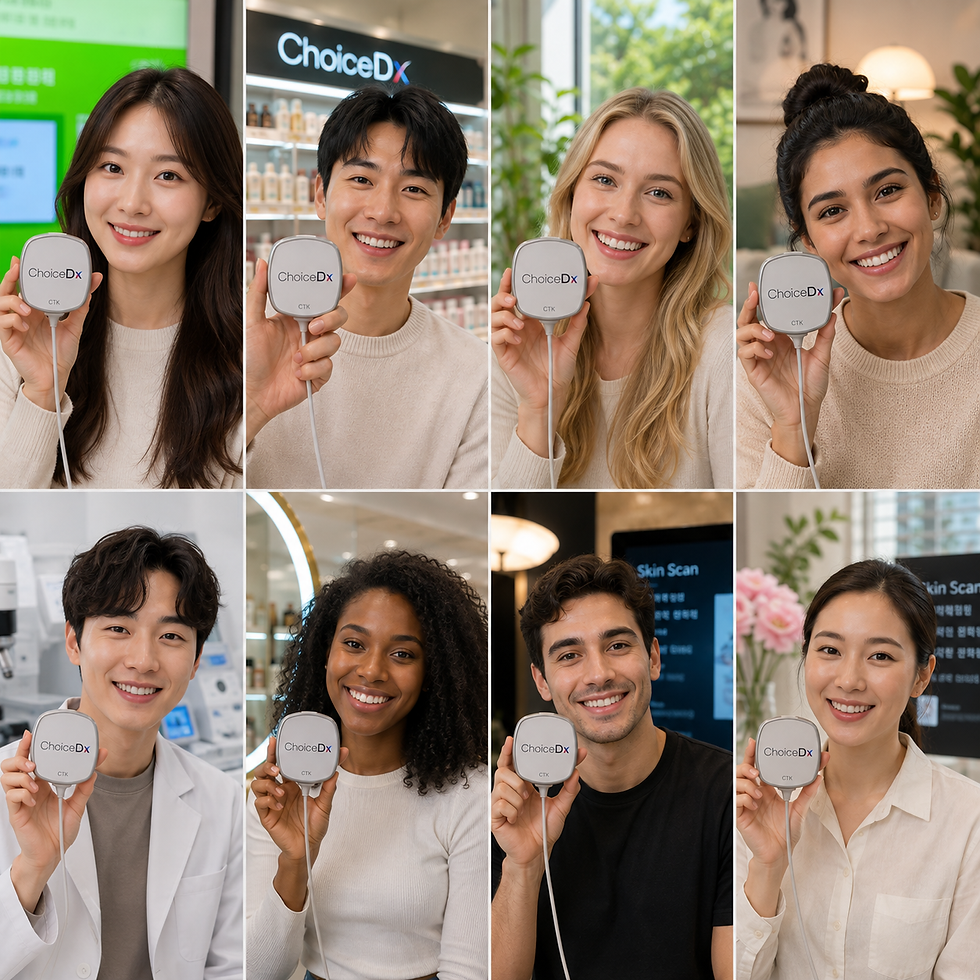
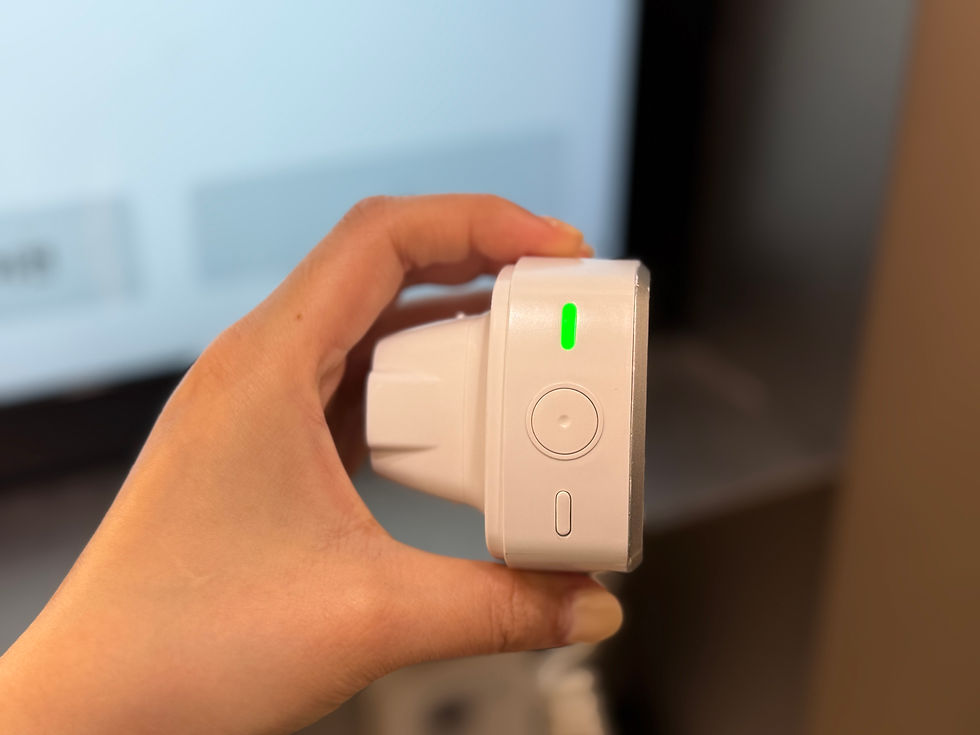
Dx-Smart is a compact professional analyzer designed with one-handed operation and portability in mind.
According to the official product information, it supports up to eight skin-analysis metrics and six scalp and hair metrics.
It can be considered for consultation counters, aesthetic environments, salons, pop-ups, and other professional spaces where flexible operation is important.
Dx-Prime
Dx-Prime is a premium wireless analysis system designed for professional skin, scalp, and hair analysis environments.
It can be considered for spaces where professional consultation and repeat customer management are important.
Rather than asking which device is universally better, it is more useful to begin with:
customer volume, consultation time, capture areas, mobility, space, and how products or treatments will connect to the result.
The device should follow the workflow—not the other way around.

Where Can Professional AI Analysis Be Used?
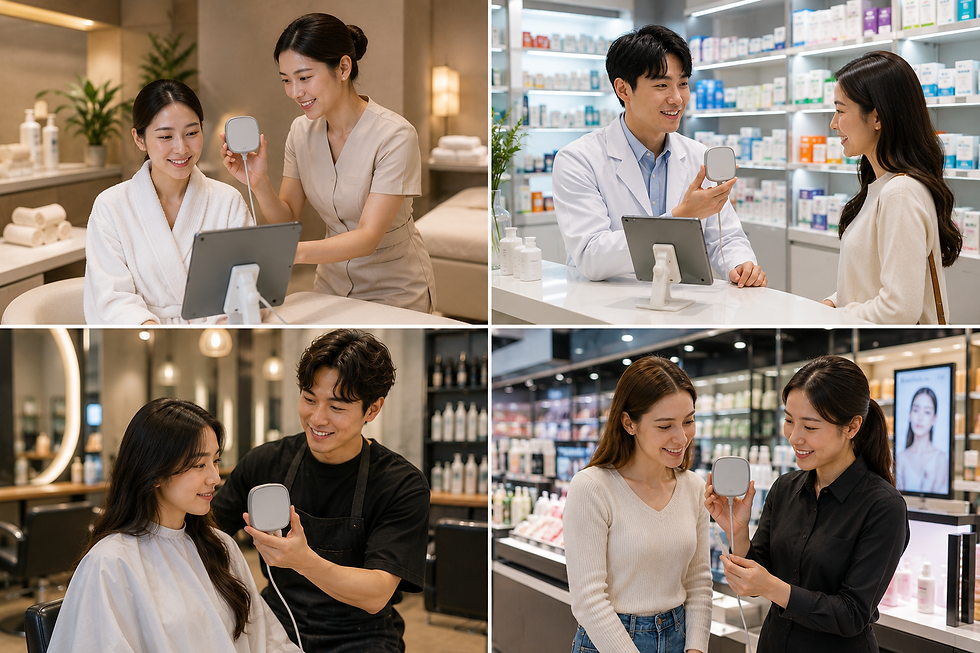
Beauty brand countersUse analysis results as a reference when explaining products within the brand portfolio.
Aesthetic centers and spasReview current condition before care and compare results during future visits.
Pharmacies and dermocosmetic spacesStructure the customer’s areas of interest before discussing relevant products.
Hair salons and scalp-care centersConnect scalp and hair analysis with shampoos, scalp products, and professional care programs.
Global beauty brands and retail networksUse standardized capture, multilingual environments, and customer-history management to support more consistent consultation across stores and markets.
A More Digital Consultation Can Still Feel More Human
More AI does not necessarily mean less value for offline professionals.
When technology handles repetitive capture and information organization, professionals can spend more of their time listening, explaining, and helping customers make sense of the result.
Customers are not interested only in a score.
They want to know:
Why did I receive this result?What should I pay attention to first?Which products and care options fit my lifestyle?
Those questions still require human interpretation.
This is why the role of AI in professional beauty consultation is relatively clear.
AI should not replace the consultation.It should create better evidence for professionals to explain.
The goal is not to choose between technology and people.
It is to use data so professional expertise can be communicated more clearly.
Frequently Asked Questions
Does AI skin analysis replace professional consultation?
No. In professional beauty environments, AI can capture and structure skin information while the professional adds context such as product history, lifestyle, and customer concerns.
Why is repeat measurement important?
A one-time result is useful, but repeat measurements under comparable conditions can make follow-up consultation more meaningful by showing the direction of change.
Can customer results be managed over time?
ChoiceDx Professional materials describe customer-data comparison and management as well as Data Hub-based operating structures. Actual storage and management should be designed according to system configuration and customer consent.
Can skin tone affect AI analysis?
In image-based analysis, skin tone and imaging conditions can affect the input image. Diverse validation, standardized capture, and appropriate calibration are therefore important.
Where is professional AI analysis useful?
Beauty counters, aesthetic centers, spas, pharmacies, dermocosmetic spaces, hair salons, scalp-care centers, and professional beauty retail environments can all consider AI-supported consultation.
Is AI skin analysis a medical diagnosis?
No. General ChoiceDx beauty analysis is non-medical information intended to support understanding of skin, scalp, and hair condition, beauty consultation, and product or care exploration.
What Kind of AI Analysis Environment Fits Your Consultation?
The right configuration depends on the business.
How many customers are consulted each day?
Will you analyze only skin, or scalp and hair as well?
Is the relationship one-time or recurring?
Is the consultation centered on products or treatments?
Do multiple locations or countries need to follow a consistent standard?
The answers influence the required hardware, software, consultation station, and data-management structure.
ChoiceDx can combine professional skin, scalp, and hair analyzers with Embedded Solutions and customer-data management according to the operating environment. Its Professional materials include tablet-based counselor stations designed around professional use and customizable configurations.
Good consultation is not about recommending more products.
It is about connecting the right information to the right customer in a way they can understand.
Rather than simply adding another device,
the goal is to create an environment where better consultation can happen.

![[On-site Report] “The Future of K-Beauty in Dubai” — ChoiceDx Captures Middle Eastern Buyers’ Attention with AI Skin & Scalp Analysis](https://static.wixstatic.com/media/a716c2_7c292c1929a54f40818a431603e87b3e~mv2.png/v1/fill/w_740,h_987,al_c,q_90,enc_avif,quality_auto/a716c2_7c292c1929a54f40818a431603e87b3e~mv2.png)
![[MBC News Report] From New York’s SoHo to the Upper East Side, ‘ChoiceDx’ Stands at the Center of K-Beauty’s Offline Innovation](https://static.wixstatic.com/media/a716c2_806fbf5710524601aa1e74d82f7404ee~mv2.png/v1/fill/w_980,h_516,al_c,q_90,usm_0.66_1.00_0.01,enc_avif,quality_auto/a716c2_806fbf5710524601aa1e74d82f7404ee~mv2.png)


