How Can AI Skin & Scalp Analysis Be Used in Health & Beauty Retail? | Watsons Malaysia
- ChoiceDx

- 7 days ago
- 12 min read
Updated: 6 days ago
The More Products a Store Offers, the More Important It Is to Understand the Customer First
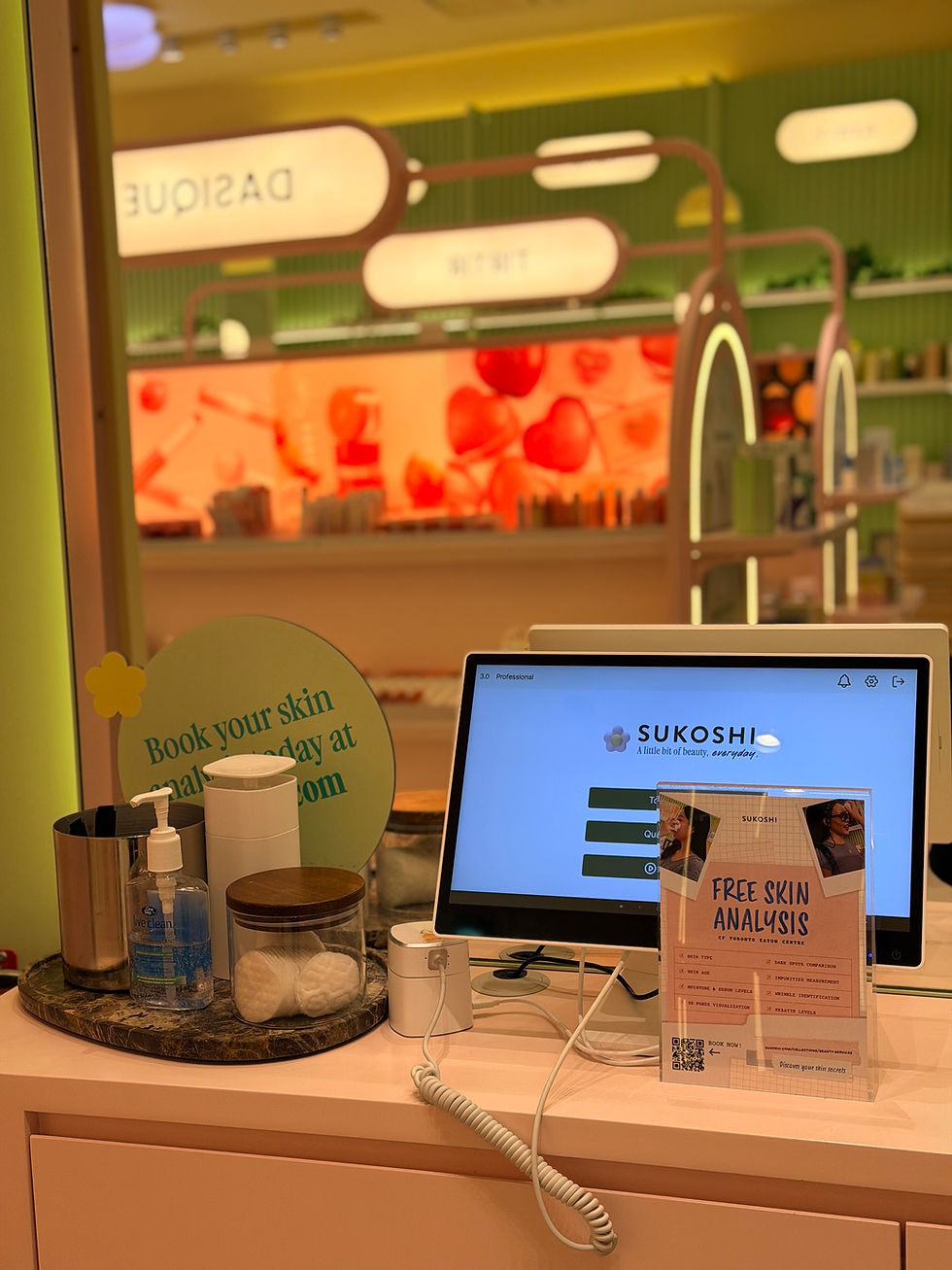
AI skin and scalp analysis at Watsons Malaysia
One of the biggest strengths of a health and beauty store is choice. Skincare and makeup sit alongside shampoos, scalp-care products, personal care, health products and more. For customers, however, that abundance can sometimes create another problem.
“With all these products in front of me, where should I start?”


That is what makes the ChoiceDx case at Watsons Malaysia particularly interesting. A real in-store environment has been launched where customers can experience skin analysis followed by scalp analysis in one place. This is not an exhibition concept, but an application being used in an actual retail setting.
Skin analysis itself is no longer particularly unusual in a cosmetics store. But when customers can naturally move from facial skin to scalp and hair, the experience begins to mean something different. In a health and beauty retailer such as Watsons—where skincare, haircare, personal care, health products and pharmacy services coexist—it may be more useful to understand a customer as one person rather than as a collection of separate product categories.

What changes when a customer who came for skincare also checks their scalp?
Customers rarely walk into a store with only one concern. Someone may feel that their face is dry while their scalp becomes oily easily. A customer shopping for skincare may suddenly remember a scalp concern they have had recently. The reverse can happen too: someone choosing shampoo may notice a skin-analysis station and think, “Maybe I should check my skin as well.”
Watsons Malaysia currently operates more than 800 stores nationwide and carries skincare, cosmetics, haircare, personal care, OTC medicines and health supplements. It also offers beauty-advisor and pharmacy services. In that context, an experience that looks at both skin and scalp fits naturally with the broader range of categories available in the store.
The point is not to show customers more results. Looking at both skin and scalp can give customers a clearer basis for deciding what deserves their attention in the store. Instead of beginning with a vague intention such as “I need to buy some beauty products today,” the question can become “What should I pay attention to first in my skin and scalp right now?”
The greater the assortment, the more useful that kind of starting point can become. Once customers understand their own condition, categories that may have seemed separate—skincare, haircare and scalp care—can begin to connect around one person’s overall care experience.

What is different about seeing products first versus understanding your condition first?
Introducing AI skin and scalp analysis does not mean a retailer needs to replace its existing product-recommendation model. But when customers check their areas of interest before browsing products, the starting point of the shopping journey can change.
Category | Product-first shopping | Shopping supported by analysis |
Starting point | Bestsellers, new products, promotions | Customer’s skin and scalp areas of interest |
Customer question | “What is popular right now?” | “What should I look at first?” |
Product discovery | Compare across the full category | Narrow the range by starting with relevant categories |
Role of staff | Explain product features and usage | Review the analysis alongside the customer’s actual concerns |
Personalization | Based mainly on sales ranking and category | Based on condition, areas of interest and consultation context |
Role of analysis | May remain a separate in-store experience | Becomes a starting point for consultation and product discovery |
Customer experience | Discovering good products | Choosing while understanding “what may be relevant to me” |
Neither approach needs to replace the other. Bestsellers, new launches and promotions remain useful ways to discover products. AI skin and scalp analysis simply adds another reference point: the customer’s current areas of interest.

Why AI analysis is not an unfamiliar direction for Watsons
Looking at Watsons’ existing services, skin and scalp analysis does not appear as an isolated new technology. Watsons has long operated an O+O (Offline plus Online) environment and incorporated a variety of digital beauty services into the customer journey.
The Watsons Malaysia app has offered tools such as ColourMe, an AR-powered virtual makeup experience; Foundation Finder, which helps customers find foundation based on skin tone and preference; and Skinfie Lab, which uses a selfie and simple questions to analyze skin and guide customers toward related products. Foundation Finder connects its recommendations directly to the Watsons online store, while Skinfie Lab also links skin information with relevant product information.
This gives a useful indication of how Watsons approaches Beauty Tech. The purpose is not simply to display technology. It is to make it easier for customers to understand themselves and navigate a large assortment of products.
From that perspective, the ChoiceDx project at Watsons Malaysia can be understood as an offline touchpoint that extends personalization beyond facial skin toward scalp and hair. It is not simply another analyzer entering the store. It is another way for the retailer to understand customer needs.

For a brand with 8,000 stores, the operating model matters more than one device
Watsons currently operates around 8,000 O+O stores and more than 1,500 pharmacies across 16 markets in Asia, Europe and the Middle East. At that scale, it is difficult to view a skin analyzer in Malaysia as only a device-installation story.
There has been no official announcement that ChoiceDx will expand to Watsons stores in other countries, so such an expansion should not be presented as fact. What the case does provide is a useful way to think about the questions global retailers need to address when evaluating AI skin analysis.
Should a flagship and a neighborhood store use the same setup? How should a customer-operated self-service model differ from a professional consultation model? Should every location offer only skin analysis, or should some include scalp and hair? As the number of locations grows, the issue becomes less about selecting one “best” device and more about designing the right experience for each store while maintaining the brand’s core consultation standards.
A global brand does not need every store to look identical. What matters more is maintaining a familiar basic experience: the customer first understands their own condition, then moves naturally toward products or consultation.


In Korea, “analyze first, then shop” is already being repeated at scale
The Olive Young Skin Scan case in Korea makes this shift easier to see. According to ChoiceDx materials, operational experience that includes Olive Young Skin Scan has exceeded one million cumulative measurements. Customers can also analyze their skin offline, review results later through digital channels and continue into related information and product discovery.
There is a meaningful difference between a one-time event and a service that has been repeated more than a million times. It suggests that checking one’s skin in a store can move beyond novelty and become part of a normal retail service experience.
Seen in the same context, Watsons Malaysia becomes even more interesting. Olive Young has extended skin-analysis experiences between physical stores and digital services, while Watsons Malaysia is introducing a format where skin and scalp can be explored in the same environment. The operating models are not identical, but they point toward a similar change.
Shopping is moving from choosing a product first and finding a reason afterward, toward understanding oneself first and then exploring products.

For global customers, “accuracy” needs a more specific definition
Accuracy is one of the first questions that comes up when evaluating an AI skin analyzer. It is obviously important. But when a system is used by customers across different markets, asking only “Is it accurate?” is not quite enough.
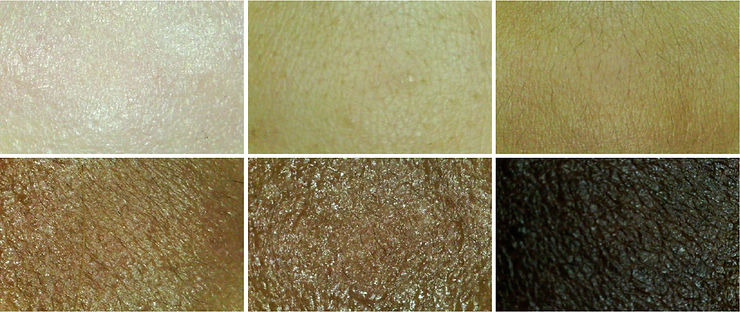
In image-based analysis, skin tone, lighting, camera conditions, shooting distance and surrounding environment can all influence the input image. It therefore makes sense to look at which skin tones were included in validation, how imaging conditions were standardized, and whether stability was evaluated when the same customer was measured repeatedly.
ChoiceDx Research included 265 participants across Fitzpatrick Phototypes I–VI. The research evaluated standardized capture under controlled lighting and camera conditions, Capture Calibration designed to reduce differences caused by skin tone and imaging environment, comparison with expert visual evaluation, and three repeated captures.
One point should be clearly separated: this study was not conducted on Watsons customers. Watsons Malaysia is a real-world retail deployment case, while ChoiceDx Research is a separate study that explains how the analysis technology itself was evaluated.
The store answers “Where and how can this technology be used?” Research answers “By what standards was the analysis evaluated?” Keeping those two questions separate creates a more credible explanation.

For businesses that see the same customer again, the next analysis may matter more than the first
High-traffic health and beauty retail often focuses on meeting many new customers quickly. Esthetic clinics, pharmacies and premium consultation environments can be different because the same customer may return repeatedly. In those businesses, the ability to compare a previous result with a current one may be more valuable than showing an impressive result once.
That is where repeat measurement becomes important. If the first image was captured under bright lighting at a short distance and the next one under completely different conditions, a numerical difference cannot automatically be interpreted as a real change in the customer.
For repeat-visit businesses, it is therefore useful to look beyond the number of analysis parameters and evaluate standardized capture, calibration and repeatability. ChoiceDx Research also examined this area through standardized capture and three repeated measurements.
Some businesses gain more value from a record that can support the next conversation than from a score displayed only once. Esthetic clinics and spas are obvious examples, but the same is true for pharmacies and scalp-care environments that maintain longer-term customer relationships.


Why the Watsons case is also interesting for pharmacies
If Watsons is viewed only as a cosmetics retailer, half of the story is missed. Its global network includes more than 1,500 pharmacies, and Watsons Malaysia also combines OTC products, health-related products, pharmacy services and beauty-advisor services.
Pharmacy customers often arrive intending to purchase something but struggle to explain what they are actually concerned about. A conversation may begin with “My skin has been very dry lately,” “It seems more sensitive,” or “My scalp feels uncomfortable.” The consultant then needs to understand the underlying concern from only a small amount of information.
In that situation, non-medical skin and scalp analysis can serve not as a tool that gives an answer, but as information that helps make the question more specific. The customer and professional can look at the current condition together, discuss what has been bothering the customer, and then explore relevant dermocosmetic or home-care categories.
The key is that analysis should not replace medical diagnosis or prescription. It is more appropriately used as supporting information that translates a vague customer concern into something that can be discussed more clearly.
Esthetic clinics look at the customer’s timeline, not only product categories
Esthetic clinics and spas need a different perspective again. What matters may be less about which product is sold today and more about explaining what has changed between the customer’s first visit and a return visit several weeks later.
At the first visit, the professional can review the customer’s current condition and explain the direction of care. At the next visit, previous images and current results can be compared alongside the customer’s own feedback and lifestyle changes. When this continues over time, the analyzer becomes less of a device for offering a new experience and more of a working reference for professional consultation and long-term customer management.
Even an esthetic clinic focused mainly on facial care may choose to expand into scalp or hair if those concerns are part of its programs. Skincare and scalp care may be separate business categories, but for the customer they are ultimately parts of one personal-care experience.
A large health and beauty retailer such as Watsons and a small esthetic clinic are completely different in scale, yet they share one important point: customers do not walk through the door as categories. They walk in as people.


Hair salons can begin by showing customers what they normally cannot see
Customers look at facial skin in the mirror every day. The scalp is different. That is why consultation in hair salons and scalp-care centers often begins with subjective language such as “It feels oily,” “I think I have more flakes,” or “My hair seems thinner.”
When the customer and professional can look at scalp and hair images together, the professional can understand the customer’s concern more specifically. From there, it becomes much more natural to explain shampoo, scalp home care, treatments or professional programs and why they may be relevant.
Showing a product first and then explaining the reason is not quite the same experience as showing the customer’s condition first and then discussing possible options.

The right skin analyzer is determined more by operating model than by industry
When searching for a professional skin analyzer, it is natural to compare the number of analysis parameters and device specifications first. That is necessary, but for a system that will actually be introduced into a store, it is often more practical to define the operating model before reading the feature list.
A high-traffic environment where customers use the system directly is different from a setting where a professional stands beside the customer and interprets the result.
Businesses also need to decide whether skin alone is sufficient, whether scalp and hair are necessary, whether the priority is a one-time experience or repeat-visit history, and whether results should connect mainly to product discovery or to longer-term care programs. Multi-store businesses must also consider how closely they need to align capture standards, customer history and operating processes across locations.


Self-service vs professional consultation vs hybrid
Which model fits our store?
Before comparing hardware specifications, it is often more useful to decide who will use the analyzer and who will explain the result.
Category | Self-service analysis | Professional consultation | Self + professional hybrid |
Typical environment | Large H&B stores, beauty retail, pop-ups | Esthetic clinics, spas, pharmacies, premium brands | Flagships, large H&B stores, multi-service beauty spaces |
Primary user | Customer | Staff or consultation professional | Customer + professional |
Customer experience | Quick direct analysis | Analysis and interpretation with an expert | Self-discovery followed by consultation when needed |
Purpose of analysis | Discover areas of interest | Explain condition and support professional consultation | Connect discovery to consultation step by step |
Important UX | Easy capture, short use time, intuitive screen | Results that are easy for a consultant to explain | Smooth connection between self-service and consultation workflows |
Repeat-visit value | Optional | Often important | Can expand depending on business model |
Customer history | Depends on operating model | Important for long-term consultation | Can connect self-service data with consultation history |
Suitable customer flow | Analysis → Interest discovery → Product exploration | Analysis → Interpretation → Consultation → Product/care | Analysis → Interest discovery → Professional consultation if needed → Choice |
For businesses serving global customers, validation across diverse skin tones and imaging environments should also be considered. If the company already operates CRM or membership systems, it is also worth deciding during implementation whether analysis results will remain isolated data or connect to the existing customer-management flow.
The more practical question is not “Which device analyzes the most?” but “What should the customer do next after seeing the result?”

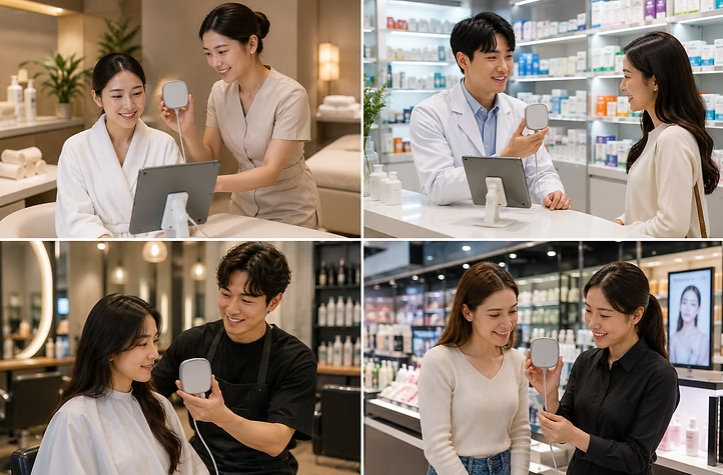
How can the same analyzer play different roles in H&B, pharmacy, esthetics and salons?
The role required from an AI skin and scalp analysis system depends on why the business meets the customer in the first place. A health and beauty retailer, an esthetic clinic, a pharmacy and a hair salon do not need to use the same result in the same way.
Business | What customers usually want to know | Main role of analysis | What follows the analysis | Particularly important capabilities |
H&B / Beauty retail | Where to start among many products | Narrow areas of interest and product categories | Skincare, haircare, professional consultation | Fast use, easy result screen, self-service operation |
Pharmacy / Dermocosmetics | How to explain their concern | Turn a vague concern into information that can support consultation | Dermocosmetic and home-care consultation | Easy-to-understand results, professional consultation use |
Esthetic clinic / Spa | Current condition and change after care | Initial consultation and repeat-visit comparison | Care programs, home care, follow-up consultation | Repeatability, customer history, previous-result comparison |
Hair salon / Scalp center | Scalp and hair conditions they cannot easily see | Review current condition visually together | Scalp care, haircare, home care | Scalp/hair imaging, result comparison |
Global brand / Multi-store | Whether consultation can remain consistent across locations | Establish common analysis and consultation standards | Customer management, product consultation, multi-store operations | Standardized capture, diverse skin tones, Data Hub |
The same system can therefore become a product-discovery starting point in H&B retail, a consultation aid in a pharmacy, a record that follows the customer over time in esthetics, and a way to make invisible scalp conditions visible in a salon.

Frequently Asked Questions
How is ChoiceDx being used at Watsons Malaysia?
A real retail environment has been launched in Watsons Malaysia where customers can experience skin analysis followed by scalp analysis using ChoiceDx.
How can AI skin and scalp analysis be used in an H&B store?
Customers can review their skin and scalp, better understand their areas of interest, and then move toward relevant product categories or staff consultation. In stores with a large assortment, analysis can also help narrow where the customer should begin.
What is the benefit of analyzing both skin and scalp?
For stores that sell both skincare and hair/scalp-care products, it makes it possible to consider several areas of interest for the same customer within one consultation experience. The actual scope should still reflect the store’s assortment and service model.
Can pharmacies use AI skin and scalp analysis?
Non-medical skin and scalp information can be used as supporting information to understand customer concerns and make dermocosmetic or home-care consultation more specific. It should not replace diagnosis or prescription for medical conditions.
What should global retailers check when comparing skin analyzers?
In addition to analysis parameters, consider validation across diverse skin tones, standardized capture conditions, Capture Calibration, repeatability, result screens that customers can understand, and consistency across multiple locations. ChoiceDx Research included Fitzpatrick I–VI skin tones, standardized capture, calibration and three repeated measurements.
Was ChoiceDx Research conducted on Watsons customers?
No. Watsons Malaysia is a real-world retail deployment case. ChoiceDx Research is a separate study evaluating the AI analysis technology itself. It included 265 participants, Fitzpatrick I–VI skin types, standardized capture, Capture Calibration, expert comparison and three repeated measurements.
Can the same customer be analyzed again and compared?
For repeat comparison, capture conditions should remain as similar as possible. Large differences in lighting, camera conditions or imaging environment can make it difficult to interpret result differences as actual changes in the customer. ChoiceDx Research evaluated stability through standardized capture and repeated measurements.