
Last K-Beauty Before Departure, First K-Beauty After Arrival|ChoiceDx AI Skin Analysis in Airport K-Beauty Retail

Updated: Sep 3
Lotte Mall Gimpo Airport, directly connected to Gimpo International Airport, is a major mixed-use retail environment where air travelers and customers from the Seoul metropolitan area come together. Gimpo Airport Station is served by Seoul Subway Lines 5 and 9, the AREX Airport Railroad, Gimpo Goldline, and Seohae Line, making the area highly accessible not only to domestic shoppers but also to international visitors to Korea.
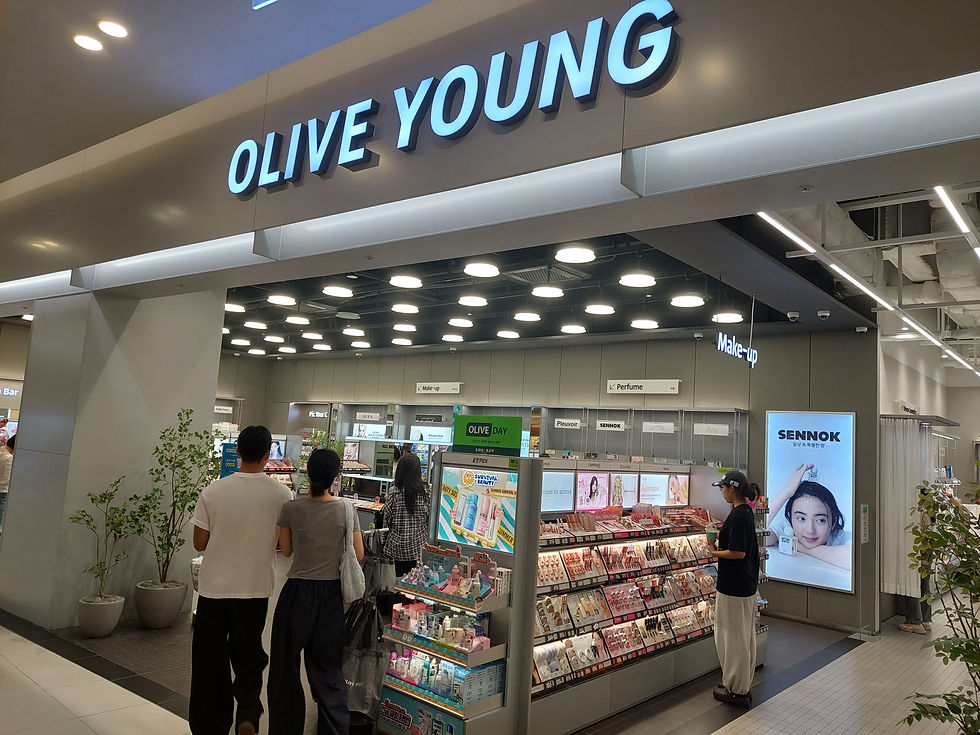
According to the actual installation status as of June 29, 2026, one ChoiceDx skin analysis system is deployed within the Skin Scan environment at Olive Young Lotte Mall Gimpo Airport. This case goes beyond the installation of a skin analyzer. It demonstrates how AI Skin Analysis can be used as a starting point for product discovery in an airport retail environment, where customer dwell time is limited and shoppers have diverse languages and reasons for visiting.
ChoiceDx is an AI skin, scalp, and hair analysis solution brand developed and operated by ChoiceTech Korea. In retail environments, the analysis experience can be designed so that customers first understand their current skin condition and then move on to relevant skincare categories or staff consultation.
What Skin Scan Means in a Gimpo Airport Retail Environment
Airport retail operates under different conditions from everyday neighborhood retail. Customers often have limited time, many international visitors are entering the store for the first time, and store staff may not be able to provide lengthy product explanations to every shopper.
In this environment, simply increasing the number of products is less important than helping first-time customers quickly identify the categories that are relevant to them.
With Skin Scan, customers can begin by checking their skin condition rather than browsing product shelves first. Based on the results, they can then explore skincare categories related to hydration, soothing, pores, skin tone, and other areas that may be relevant to their needs.


“How quickly can someone visiting this store for the first time understand what to look for?”
Olive Young at Lotte Mall Gimpo Airport is an interesting place to think about that question.
The mall is directly connected to Gimpo Airport Station, where several major transit lines meet. It serves not only air travelers but also people commuting between Seoul and the surrounding metropolitan area.
And according to the June 29, 2026 installation snapshot, one Skin Analysis system was deployed in the Olive Young retail environment at Lotte Mall Gimpo Airport.
One unit does not sound particularly remarkable.
What makes this case interesting is the location.
A last-minute beauty stop before departure—and possibly the first one after arrival
A K-Beauty store connected to an airport can play completely different roles depending on where a traveler is in their journey.
For someone leaving Korea, it can be the last chance to buy one more product.
They may want to repurchase something they tried during the trip, buy gifts for friends, or finally pick up a product they kept seeing on social media.
For someone who has just arrived in Korea, the same store can become their first introduction to Korean beauty retail.

That is a very different situation.
The customer may not know the brands yet. They may not understand the difference between toner pads, ampoules, barrier care, calming products, pore care, or brightening products.
Even someone who already likes K-Beauty can feel overwhelmed when all of those choices appear at once.
This is why it can be limiting to think of an in-store Skin Scan as simply “a machine that measures skin.”
It can change where the shopping journey begins.
Instead of starting with:
“What is the best-selling product in Korea?”
the customer can begin with:
“What should I look at first for my skin?”
That is a very different retail conversation.

When products are unfamiliar, your own face is the most familiar content in the store
Imagine explaining Korean skincare to an international customer.
The brands may be unfamiliar. Product names can be difficult. Some of the ingredients trending in Korea may be completely new to them.
A staff member could explain everything in English, of course. But in a busy store, it is difficult to give every customer a long one-on-one introduction.
Your own face, however, needs very little translation.
Once customers can look at their own skin image and see information related to pores, oil, hydration, skin tone, or other visible skin characteristics, the product shelves can begin to look different.
Before the analysis, calming, moisturizing, pore care, and barrier care may all look like similar skincare categories.
After the analysis, the customer may have a clearer idea of which category is worth exploring first.
The important point is not that AI chooses a product on the customer's behalf.
It is that the store can create a journey like this:
Analysis → Understanding the Result → Discovering a Relevant Category → Comparing Products
For travel retail, that sequence can be particularly valuable.
Regardless of what language the customer speaks, the conversation can begin with something universal:
their own skin.

In 2026, K-Beauty is exporting more than products—it is exporting how people choose them
The Gimpo Airport example becomes even more interesting when we place it alongside the recent globalization of K-Beauty retail.
In August 2026, Sephora and Olive Young expanded their collaboration in the United States. Nineteen Korean beauty brands curated by Olive Young began entering more than 500 Sephora stores and Sephora.com, with a dedicated Olive Young K-Beauty space also introduced at Sephora's Times Square flagship.
What stands out here is not only that 19 Korean brands entered the U.S.
The curation itself traveled with them.
The retailer is no longer simply transporting Korean products overseas. It is also bringing the logic used to decide which products deserve attention, which ingredients and categories are growing, and what customers may want to discover first.
Olive Young's own U.S. retail experience shows a similar direction.
Rather than simply displaying K-Beauty products, stores are introducing experiences such as Skin Scan and Beauty Lab that connect:
Discovery → Experience → Consultation → Product Exploration
The competitive landscape is changing.
The earlier story of K-Beauty overseas was:
“You can now buy Korean cosmetics in America.”
The next story may be:
“Here is how Korean beauty retail helps you choose among all of them.”
Seen from that perspective, a Skin Scan operating in a Korean travel-retail location such as Gimpo Airport is more than another domestic installation case.


The renewed attention around K-sunscreen in the U.S. belongs to the same conversation
There has also been an important development in the U.S. sunscreen market.
In 2026, the U.S. FDA moved forward with the addition of bemotrizinol (BEMT) to the OTC sunscreen framework, renewing attention around the possibility of broader localization for Korean and other global sunscreen brands in the United States.
That does not mean Korean sunscreens can simply be sold in the U.S. unchanged.
Sunscreen in the United States is regulated within an OTC drug framework rather than only as a cosmetic product, so products still need to comply with U.S. requirements regarding ingredients, labeling, and formulation.
But the broader direction is still worth watching.
As American consumers become more familiar with K-Beauty and interest expands into categories such as Korean sunscreen, stores once again face the same question:
“Out of all these products, which one should I look at first?”
That is why global K-Beauty expansion and in-store Skin Analysis are not completely separate stories.

And this is where ChoiceDx appears in the Gimpo Airport retail environment
It is important to distinguish the entities correctly.
ChoiceTech Korea develops and manufactures AI skin, scalp, and hair analysis systems, while ChoiceDx is its AI analysis solution brand.
According to the June 29, 2026 installation snapshot, one ChoiceDx skin analysis system was installed in the Olive Young Skin Scan environment at Lotte Mall Gimpo Airport.
That does not mean that Olive Young Skin Scan and ChoiceDx are the same thing.
Skin Scan is the service experience the shopper encounters in store.
ChoiceDx is the technology and analysis-system brand deployed in some of those real retail environments.
This distinction actually makes the B2B use case easier to understand.
Retailers do not ultimately want to buy “a machine.”
They want to build a skin-analysis experience that works in their own retail environment.

In airport retail, the three minutes after the scan may matter as much as the analysis itself
If I were responsible for introducing AI Skin Analysis into an airport, duty-free store, or tourist-focused retail environment, I would probably spend some time standing inside the store before reading the product specification sheet.
How quickly are customers moving?
How many minutes can a staff member realistically spend with one person?
What percentage of customers are international?
Will most customers use the system alone?
These questions can matter just as much as technical performance.
For a travel-retail Skin Analysis experience, several operating metrics could be especially useful.
Experience start rate shows how many people who notice the system actually begin an analysis. If the first screen is confusing or the instructions take too long, customers can drop out before the experience really starts.
Completion rate shows how many customers who start reach the results. In airport retail, longer experiences can create more drop-off because people are moving according to flight and shopping schedules.
Language selection can also become valuable operational data. Understanding which language groups engage most often can help retailers improve content and staffing.
And then there is the most important part:
what happens after the result.
Does the customer move toward a relevant skincare category?
Do they spend more time comparing products?
Do they ask a staff member a question?
The existence of the Skin Scan itself matters less than whether the customer's next behavior changes.


Multilingual retail is not really about translation—it is about letting people move without asking for help
When companies talk about multilingual retail, the first question is usually:
“How many languages does the system support?”
That matters.
But the practical question inside a store is more specific.
After selecting a language, can the customer reach the capture stage without staff assistance?
Can they understand face-positioning and capture instructions?
Can they identify the important part of the result?
Can they understand what to do next?
In other words, the goal of multilingual UX is not simply to add more translated text.
It is to help international customers continue the journey on their own.
This becomes especially important in airports, duty-free environments, and tourist districts.
Instead of expecting one employee to repeatedly explain the same basic process in Korean, English, Japanese, and Chinese, the digital experience can handle the repetitive onboarding while employees step in when real consultation is needed.
The goal is not a store without employees.
It is a store where employees can spend less time acting as instruction manuals.
That is a much more realistic role for AI Skin Analysis in travel retail.

Why a Gimpo Airport installation can matter to a global retail buyer
Why should a retailer in the U.S., Europe, Japan, or Southeast Asia care about one Korean store?
Because the value of a reference depends on how it is framed.
If the story is simply:
“We installed a Skin Analyzer at Gimpo Airport.”
the meaning is limited.
But if we look at the retail context—the airport-connected mall, the mix of domestic and international shoppers, short visit times, multilingual needs, and K-Beauty product discovery—the case becomes something different.
It becomes:
“A real retail example of using skin analysis as the entry point to K-Beauty shopping for customers with different languages and limited dwell time.”
A K-Beauty retailer, department store, pharmacy, travel-retail operator, or beauty select shop overseas can immediately begin asking its own questions.
Could customers in our store complete the analysis without help?
Should we include scalp analysis as well?
At what point should a beauty advisor step in?
If we roll it out to several locations, can we maintain the same experience?
A strong retail reference is not simply a page saying:
“We installed this too.”
It should help another retailer imagine:
“How would this work in our store?”

Selling one more product before departure may matter less than leaving one memorable experience
Airport shopping is brief.
Customers may not remember every brand they saw.
Packaging is beautiful everywhere, and K-Beauty bestsellers change quickly.
But the memory of
“I had my skin analyzed in Korea.”
can be different.
The technology itself may not be what the traveler remembers.
They remember their own face and their own result.
That is why AI Skin Analysis in airport K-Beauty retail does not necessarily need to be judged only by immediate product conversion.
It can also become a compact way to experience Korean beauty retail—turning K-Beauty from a shelf of products into a way of shopping that begins with understanding yourself.
That is what makes the Olive Young Lotte Mall Gimpo Airport Skin Scan case interesting.
As K-Beauty continues to expand globally, the next competition may shift from:
how many Korean products can be placed overseas
to
how easily customers can discover, understand, and choose among them.
And an airport—where multiple nationalities, short dwell times, and fast shopping decisions all meet—may be one of the most interesting places to test that future.
FAQ
Can I expect the same Skin Scan configuration at every Olive Young near Gimpo Airport?
Not necessarily. Skin and scalp analysis configurations can vary by location. The installation information in this article is based on the June 29, 2026 installation snapshot, so actual operating status may differ at the time of visit.
Is ChoiceDx the same thing as Olive Young Skin Scan?
No. ChoiceDx is the AI skin, scalp, and hair analysis solution brand developed and operated by ChoiceTech Korea. ChoiceDx systems are deployed in some Olive Young Skin Scan retail environments, while Skin Scan refers to the in-store customer service experience.
Can similar skin-analysis experiences be introduced into overseas K-Beauty or airport retail stores?
The appropriate setup depends on store size, customer languages, dwell time, staffing, whether skin and scalp analysis are required, and whether the experience is self-service or advisor-led. In travel retail, analysis time, multilingual UX, the moment at which staff join the journey, and what happens after the result should be designed together.
Want to create a reason for customers to choose—not just another product shelf?
Installing one skin analyzer is only one part of the project. What matters is how the customer journey is designed before and after the analysis.
For airports, duty-free stores, department stores, shopping malls, pharmacies, and K-Beauty specialty retail environments, ChoiceTech Korea can help review configurations based on actual retail deployment experience.
ChoiceDx AI Skin, Scalp & Hair Analysis Systems
Nationwide Retail Deployment Cases
Retail & Global Project Inquiry

![[On-site Report] “The Future of K-Beauty in Dubai” — ChoiceDx Captures Middle Eastern Buyers’ Attention with AI Skin & Scalp Analysis](https://static.wixstatic.com/media/a716c2_7c292c1929a54f40818a431603e87b3e~mv2.png/v1/fill/w_740,h_987,al_c,q_90,enc_avif,quality_auto/a716c2_7c292c1929a54f40818a431603e87b3e~mv2.png)
![[MBC News Report] From New York’s SoHo to the Upper East Side, ‘ChoiceDx’ Stands at the Center of K-Beauty’s Offline Innovation](https://static.wixstatic.com/media/a716c2_806fbf5710524601aa1e74d82f7404ee~mv2.png/v1/fill/w_980,h_516,al_c,q_90,usm_0.66_1.00_0.01,enc_avif,quality_auto/a716c2_806fbf5710524601aa1e74d82f7404ee~mv2.png)


